We have started working at Smiths Lake, Pacific Palms, on the Mid North coast of New South Wales. . It is quite a beautiful site and we are building quite an affordable building. We will keep you posted.
Everyone’s opinion on earth buildings vary, but this interview adds a great perspective. Ronald Rael, architect, blogger and publisher of book Earth Architecture is interviewed by Myoo
This from inhabitat: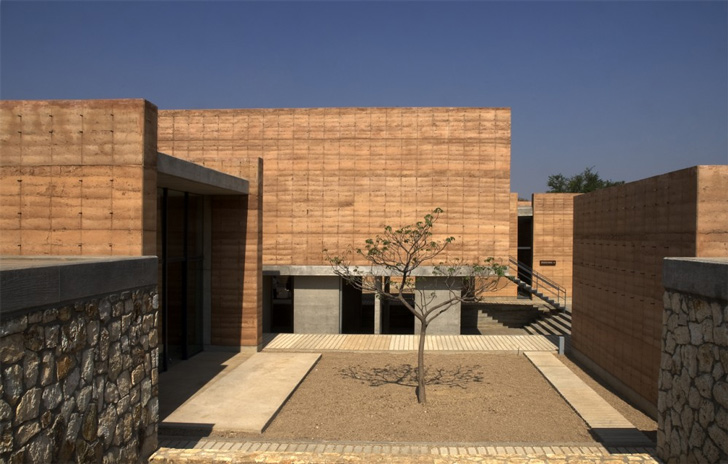
This art school in Oaxaca, Mexico where Taller de Arquitectura worked with artist Francisco Toledo to create a truly organic campus that includes an earth-bermed stone walled building, ample courtyards, and native low-water plantings. Large north-facing windows provide plenty of natural light, cross-ventilation helps keep the indoor from becoming stuffy, and the massive walls minimize ambient noise.
They go one to say: “We could argue that the greenest new building is the one made from materials sourced from right where it is built.”
 PATRICIA McARDLE wrote this opinion piece for the New York Times:
“American taxpayers’ dollars are also being used for energy-inefficient construction projects. During my year in Afghanistan, I sat for hours in meetings with local officials in remote mountain and desert locations, sweating or freezing — depending upon the season — inside concrete and cinder-block schools and police stations built with American aid. These projects are required to adhere to international building codes, which do not permit the construction of traditional earthen structures.”
“These structures are typically built with cob — a mixture of mud, sand, clay and chopped straw molded to form durable, elegant, super-insulated, earthquake-resistant structures. With their thick walls, small windows and natural ventilation, traditional Afghan homes may not comply with international building codes, but they are cooler in summer and warmer in winter than cinder-block buildings. They also last a long time. Some of Afghanistan’s oldest structures, including sections of the defensive wall that once surrounded the 2,000-year-old Silk Road city of Balkh, are made of cob and rammed earth. In England, people are still living in cob houses built before Shakespeare was born.”
Assoc Prof Terence Williamson of the School Architecture, Landscape Architecture at Adelaide University, in conjunction with the Earth Building Association of Australia and the Nillumbik Mudbrick Association, is conducting a survey into the performance of rammed earth and mud brick houses.
The study aims to find out how people use and think about their houses. Knowledge about living in an earth building, what it’s really like and the feelings people have about the comfort of their home are the main things the research aims to discover. The more that is known about such factors, the better are the chances of designing such houses that are sustainable and suitable for different people in different places.
To gather the information an on-line questionnaire has been set up. Preferably this questionnaire should be filled out by the person of the household over the age of 25 years who spends most of the time at home, but really any household member over this age may fill out the questionnaire.
Please click on this link. We will try and provide the results when they are released.
We blog about earth building and efficient designs, but we pay our bills by building rammed earth walls on the east coast of Australia.
This is a post from a great school in Thailand called Panyaden School that has taked sustainability quite seriously with beautiful results. What impresses most is the graph about the thermal efficiencies of rammed earth.
By Markus Roselieb @ Panyaden School
Rammed earth is ideal for hot and dry climates because of its great capacity to store heat. Therefore it is perfect for Chiang Mai during the dry season where we have hot days and cool nights. The heat gets absorbed by the rammed earth walls during the day and is released into the surroundings during the night. In this way, it balances out the temperature of the surrounding area.
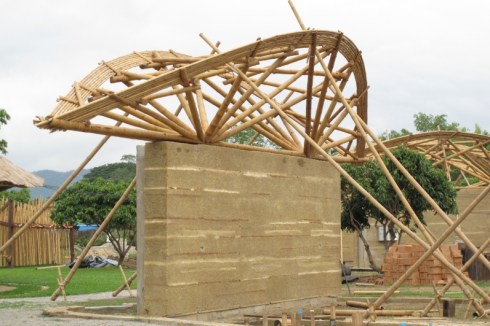
Rammed Earth and Bamboo at Panyaden School
In the case of a high moisture content in the environment, rammed earth is very suitable as it has good moisture absorption. The humidity content of the earth when it is dried out is very low. The earth can absorb up to 30 times more water than concrete which means that in the long and heavy rainy season, the rammed earth walls will absorb the moisture of the environment, and balance out the moisture content, providing a mold- and fungus-free space.
Comparing Thermal Performance
The table below compares the thermal performance of classrooms built with two different types of walls.
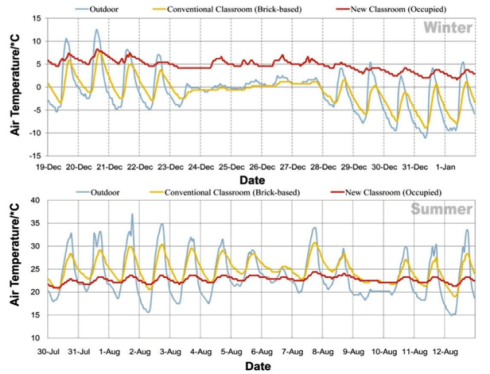
Thermal Efficiencies of rammed earth
Source: Earth Architecture in Western China
Red curve = indoor temperature in a rammed earth classroom (like those in Panyaden)
Yellow curve = indoor temperature in a conventional brick and concrete-based classroom
Blue curve = outdoor temperature
It is obvious from the study above that the indoor temperature of the earth classroom is always stable. In summer, it swings only between 21oC and 24oC. In winter, without any energy consumption for heating, it can reach an acceptable indoor comfort.
If you touch earth, concrete, steel and asphalt that are exposed to the sun, you will find that the different materials have different temperatures. The metal will be by far the hottest, followed by asphalt, then concrete (both are still so hot that you cannot walk barefoot on them for more than a few minutes). The earth will, however, be cool.
A concrete building is like an oven in which an air-conditioned interior space is inevitable. On the other hand, rammed earth has an excellent thermal mass because of its high density, and the high specific heat capacity of the soils used in its construction. It can store the heat during the day and release it slowly into the surroundings during the night. This energy-saving feature is one reason why we built our classrooms with this technique.
Article via http://arquitecturasdeterra.blogspot.com/
This is a great movie, that shows you just how important Dirt is to us. It is something we take for granted but is fast disappearing.
“Most of the world considers dirt a viable building material”
I think it was Ben Harper that said “what’s from the earth, is of the greatest worth.”
“Rammed earth may be a future building material in north-west Indigenous communities if a study at The University of Western Australia proves successful.” The UWA team will submit their findings to Standards Australia for a national rating of rammed earth. Read more at Science alert.
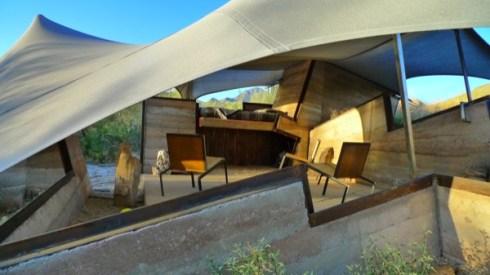 Check out this design. Quite interesting use of thermal mass. The rammed earth fireplace has a bed on top and is covered with a a tent like roof structure. It is the work of Simón De Agüero, a grad-student at the Frank Lloyd Wright School of Architecture. Check out his site here.






 Earth Dwellings