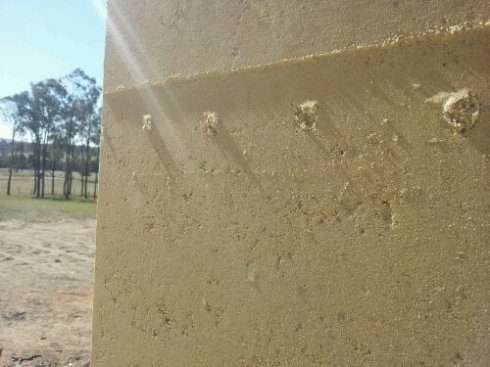
The following article recently appeared in London’s leading financial newspaper. It leads the article by saying . The world’s most primitive building material – earth – is being used to create some of our most advanced homes. The article goes on to say… “The ability of earth to moderate humidity and temperature is another advantage, which eliminates the need for expensive central heating and air conditioning.” Continue reading here.
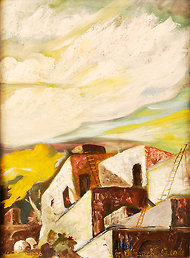
“In El Rancho Grande,” by Woody Guthrie (1936; Santa Fe, N.M.), oil on board.
Johnny Deep on the book he is editing by Woody Guthrie “…in the midst of a prolonged drought; global warming is a scientific fact; and wildfires, blizzards and tornadoes increasingly ravage the American landscape. The unerring rightness of adobe living is now more apparent than ever. It’s almost as if Guthrie had prophetically written “House of Earth” with the summer of 2012 in mind.”
We temporarily took the word “coast” out of our name and headed to armidale to help John Kleeman build stage one of his house on the outskirts of admidale. Take a look at some of the photos. We will be returning in the next couple of months for stage 2 and 3.
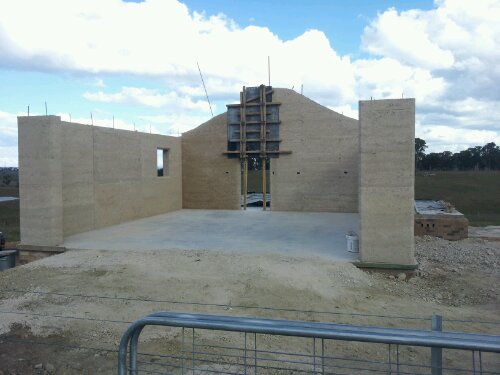
Armidale rammed earth, new england

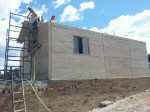

 If you are one this site, you probably know of the great thermal performance of rammed earth when used with solar passive designs; and everyone one knows of the benefits and uses of insulation,such as strawbale.
We have always wanted to do a hybrid house with the thermal mass on the northern parts of the house and strawbale on the southern sides. Fortunately we hopefully have one such project starting soon.
Recently we had a job delayed and were able to helped the guys at Straw and Clay do the final render coat. It was a real pleasure, like icing a cake so to speak, and it looked really impressive.
Check out this image and contact John or Harold if you are after some strawbale.
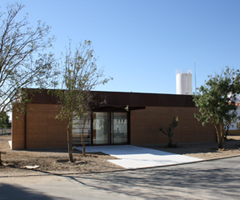
One of the main objectives of Terra Incognita project is to raise public awareness for earth architecture, its heritage and its current applications.
To this end, Terra Incognita’s partners created a Label entitled “Outstanding Earthen Architecture in Europe”.
The main goal of this label is to provide awareness to the general public for the existence of earthen buildings in Europe, but also to encou
rage its safeguard and the development of an earthen contemporary architecture.
Three categories will be distinguished in this label:
– category 1 : “Buildings with archaeological, historical or architectural interest”
– category 2 : “Buildings subjects of a remarkable
and relevant intervention (restoration, rehabilitation or extension)”
– category 3 : “Buildings built after 1970”
Please find the awarded buildings in the online digital catalogue: Outstanding Buildings Award (Download as pdf)
Sirewall is a Canadian rammed earth company and they have just produced this amazing video that sums up many of the reasons for building with rammed earth. If you live in North America, check them out. www.sirewall.com
Following is a interview on ABC (Australian Broadcasting Comission) radio’s bush telegraph program.

A rammed earth house in Derby in Western Australia (Daniela Ciancio)
Click here to listen to Bush Telegraph
Innovation and social development has driven the department of housing WA to choose rammed earth houses. It was the thermal qualities and operational costs of the house that was important to them plus it makes a comfortable house.
Dr Daniela Ciancio who started in concrete engineering has become interested in Rammed Earth because it is “durable, tough and strong”.
This project in Pakistan just won the Holcim award for sustainability. Hopefully some aid agencies and NGO’s are watching and take note of the local materials used.

This school project in the small village of Jar Maulwi, 35km northwest of Lahore, is an extension of the existing Tipu Sultan Merkez School, which has provided education for underprivileged rural girls for more than ten years. The new two-story building, Earthen School Tipu Sultan Merkez, constructed from locally-sourced cob and bamboo will provide seven new classrooms. Mitigating earthquake risks, the structure is divided into two compact parts connected by a light gallery. The 60cm thick ground floor walls are made of cob, a mixture of clay, sand, straw, water and earth and supported by brickwork foundations which protect against moisture ingress from the soil or rainwater.
The upper floor is a bamboo construction with an earthen filling. Intense research on cob construction resulted in a useful increase in strength and durability, and extended maintenance intervals compared to former methodologies. The high humidity absorption capacity and significant mass of the earth walls reduce interior temperatures by up to 8°C during summer where temperatures exceed 40°C. South-oriented glazing produces solar gain during winter. The local residents build the school and are thereby educated in this improved approach which creates an opportunity to establish their own local enterprise and transfer this highly appropriate construction technology to other building projects.
Comment of the Holcim Awards jury Asia Pacific
The jury commended this project because it contributes to all of the competition’s “target issues” in a convincing way. Through engineering and design, a traditional building technology has been upgraded with effective low-tech measures. Bamboo is used in an innovative way, demonstrating the potential in construction of this fast-growing and widely available material, which also counters deforestation. The propagation of the new construction methods amongst the local population aids the establishment of local businesses and improves the economic situation in this rural area. All materials are locally sourced and can be processed with low energy requirements.
The new construction approach shows the rural population an affordable, high quality and durable alternative compared to widely-used, but higher-cost and less environmentally-compatible construction materials. The combined earth/bamboo structure allows two-level buildings which reduces land use. The low-tech but sophisticated approach creates the potential to develop a unique local architecture, and transfer the approach to many other regions, particularly in less-developed countries.

There is a lot of earth building going on out there, so it is good to see some exposure in Melbourne’s Herald Sun. It is the story of a Monbulk builder Nathan Schroder constructing a rammed earth house in a fire prone area.
“It feels a whole lot more natural,” he said. “Two-thirds of the world’s population live in an earth dwelling but in the West we keep inventing all these new ways of building walls. This is a simple way of building and something feels really good about it.”
This video isn’t about rammed earth, sorry about that. The song alone is worth a post, a great song by Willie Nelson covering Cold Play’s “the Scientist”.
The film, by film-maker Johnny Kelly, depicts the life of a farmer as he slowly turns his family farm into an industrial animal factory before seeing the errors of his ways and opting for a more sustainable future. Both the film and the soundtrack were commissioned by Chipotle to emphasize the importance of developing a sustainable food system.
No body said it was easy!






 Earth Dwellings